QURAN
What Is Tajweed? A Beginner's Guide to Quran Recitation Rules
Tajweed is the set of rules for reciting the Quran correctly. Learn what it means, why Muslims study it, the core rules for beginners and how to start learning.
Tajweed is the set of rules for pronouncing the Quran's Arabic letters correctly, with each letter given its proper sound, length and quality. The word comes from an Arabic root meaning "to improve" or "to make excellent", so tajweed literally means reciting well. When people talk about a reciter with "beautiful tajweed", they mean someone whose letters are precise, whose vowels are held for the right length and whose recitation follows the way the Quran has been passed down orally, teacher to student, since the time of the Prophet Muhammad ﷺ.
This guide explains what tajweed is, why Muslims learn it, the handful of rules every beginner meets first, and a realistic way to start.
Key Takeaways
- Tajweed is the set of pronunciation rules for reciting the Quran: where each letter is produced, how it sounds, and how long vowels are held.
- The Quran itself asks for measured recitation: "recite the Quran ˹properly˺ in a measured way" (Al-Muzzammil 73:4).
- Beginners usually start with six topics: the articulation points (makharij), the qualities of letters (sifat), the rules of noon sakinah and tanween, qalqalah, madd (lengthening) and ghunnah (nasal sound).
- Mistakes that change a word or its meaning are treated as serious; scholars differ on whether the finer rules are obligatory or recommended for every individual. A qualified teacher is the best guide.
- Tajweed is learned by listening and reciting to a teacher, not from books alone.
What Does Tajweed Mean?
Tajweed (تجويد) is the discipline of reciting the Quran with every letter pronounced from its correct place and with its correct characteristics. Wikipedia's overview summarizes it as "a set of rules for the correct pronunciation of the letters with all their qualities" (Wikipedia, "Tajwid").
Two ideas sit at the heart of tajweed:
- Haqq al-harf (the right of the letter): the sound every letter always has, such as where it comes from in the mouth or throat and whether it is heavy or light.
- Mustahaqq al-harf (what the letter is owed in context): changes that happen when letters meet, such as merging, nasalizing or lengthening.
Tajweed is related to, but not the same as, the qira'at, the recognized ways of reciting the Quran that are transmitted through chains of teachers. Tajweed is the toolkit of pronunciation rules; a qira'ah is a specific transmitted reading. The rules in this guide follow the reading known as Hafs from 'Asim, the one most beginners in the English-speaking world learn first.
Why Do Muslims Learn Tajweed?
Muslims learn tajweed because the Quran is recited as worship, and its words are meant to be read the way they were revealed and taught. Several primary sources shape this attitude.
The Quran asks for measured recitation. In Surah Al-Muzzammil, Allah tells the Prophet ﷺ to "recite the Quran ˹properly˺ in a measured way" (Al-Muzzammil 73:4, translation by Dr. Mustafa Khattab on Quran.com). The Arabic phrase is wa rattil il-Qur'ana tartila, and tartil has long been explained as slow, clear recitation with each letter given its due. The same root appears when Allah describes how the Quran was revealed: "We have revealed it at a deliberate pace" (Al-Furqan 25:32).
The Prophet ﷺ recited with care. When Qatadah asked Anas ibn Malik how the Prophet ﷺ recited, Anas said he used to prolong certain sounds (Sahih al-Bukhari 5045). In the next report, Anas demonstrated by reciting Bismillah ir-Rahman ir-Rahim and lengthening the vowels in Bismillah, ar-Rahman and ar-Rahim (Sahih al-Bukhari 5046). Lengthening (madd) is one of the core tajweed rules covered below.
Effort is rewarded, even when it is hard. 'Aishah reported that the Prophet ﷺ said that the one who is skilled in the Quran will be with the noble, righteous scribes, and the one who recites it while stumbling and finding it difficult will have two rewards (Sahih Muslim 798a; a similar wording is in Sahih al-Bukhari 4937). For a beginner, this hadith is a strong encouragement: the struggle of learning is itself rewarded.
Is Tajweed Obligatory?
Books of tajweed divide recitation mistakes into two kinds. A clear mistake (lahn jali) is an obvious error, such as swapping one letter for another, adding or dropping a letter, or changing a vowel, which anyone who knows Arabic can hear. A hidden mistake (lahn khafi) is a subtler slip in applying the rules, such as shortening a required lengthening, which usually only a trained reciter notices (SurahQuran.com, "Hidden and clear errors in recitation"). Clear mistakes are treated as serious because they can change the words of the Quran.
On the finer rules, scholars hold different positions. A fatwa published by Islamweb summarizes them this way (Islamweb fatwa 454147, 2022):
- Obligatory: earlier scholars, including Ibn al-Jazari, held that the rules he set out, such as those for noon, tanween and certain types of madd, are binding on every reciter.
- Recommended: many later scholars distinguish a religious obligation, which protects the letters and meaning of the words and whose neglect is sinful, from a technical one, the finer points of the craft, which they regard as recommended rather than sinful to miss.
Separately, learning the science of tajweed in depth is often described as a communal obligation, so the community must always have people who know it well (Wikipedia, "Tajwid"). This article does not give a ruling. If you want to know what applies to you, ask a qualified teacher or scholar you trust.
Where Do Tajweed Rules Come From?
The rules of tajweed describe a recitation that already existed: the Prophet ﷺ taught the Quran orally to his companions, and they taught the next generation the same way. The rules were written down later to protect that oral recitation as Islam spread among people whose first language was not Arabic.
According to Wikipedia's summary of the history, scholars began recording the rules in the Abbasid era, and Abu 'Ubayd al-Qasim ibn Sallam (died 838 CE) is credited with one of the first recorded works on the readings. The scholar Ibn al-Jazari (1350 to 1429 CE) later wrote influential works on the ten readings (Wikipedia, "Tajwid"). His short teaching poem on tajweed, known as al-Muqaddimah al-Jazariyyah, is still studied chapter by chapter by tajweed students (SurahQuran.com, "Structure and chapters of the poem").
For a beginner, this means the rules are a description of how the Quran sounds when recited as it was taught. That is why tajweed is always learned with a teacher who has learned it from a teacher.
The Core Tajweed Rules Every Beginner Meets
Most beginner tajweed courses cover the same six topics. Learning their names and basic idea gives you a map, even before you can apply them fluently.
1. Makharij: Where Each Letter Comes From
The makharij (singular makhraj) are the articulation points: the exact place in the throat, tongue, lips or nasal passage where a letter is produced. The widely taught system counts 17 articulation points, grouped into five areas: the empty space of the mouth and throat, the throat, the tongue, the lips and the nasal passage (Wikipedia, "Tajwid").
Many Arabic letters that sound alike to an English speaker come from different makharij. For example:
- ح (ha) comes from the middle of the throat, while ه (ha) comes from the deepest part of the throat.
- ع ('ayn) comes from the middle of the throat, while ء (hamzah) is a short stop at its deepest part.
- ق (qaf) comes from the back of the tongue near the throat, while ك (kaf) comes from a point slightly further forward.
Getting these right matters, because swapping one letter for another can change the word entirely.
2. Sifat: The Qualities of Letters
The sifat are the characteristics of each letter: whether it is heavy (tafkhim) or light (tarqiq), whether air flows with it, whether the sound is strong or soft. Heavy letters such as ص ض ط ظ ق fill the mouth; light letters do not. Beginners usually learn heaviness and lightness first, because it is the quality you can hear most easily. Some letters share an articulation point and differ only in their qualities: ص (sad) and س (sin) come from the same place, but sad is heavy and sin is light.
3. Noon Sakinah and Tanween: Four Rules
A noon sakinah is a noon with no vowel (نْ), and tanween is the doubled vowel ending that sounds like "-un", "-an" or "-in". What happens to that "n" sound depends on the letter that follows it. There are four rules:
| Rule | Arabic | What happens | Letters that trigger it | Example |
|---|---|---|---|---|
| Izhar | إظهار | The "n" is pronounced clearly | The six throat letters: ء ه ع ح غ خ | أَنْعَمْتَ an'amta (1:7) |
| Idgham | إدغام | The "n" merges into the next letter | ي ر م ل و ن (with nasal sound for ي ن م و; without it for ل ر) | فَمَن يَعْمَلْ faman ya'mal (99:7); مِّن رَّبِّهِمْ min rabbihim (2:5) |
| Iqlab | إقلاب | The "n" turns into a hidden "m" with nasal sound | ب only | مِنۢ بَعْدِ min ba'di (2:27) |
| Ikhfa | إخفاء | The "n" is partly hidden with a nasal sound | The remaining 15 letters | مِن شَرِّ min sharri (113:2) |
The letter lists above follow the summary in Wikipedia's "Tajwid" article. Students often memorize the idgham letters with the word yarmalun (يرملون), which spells them out.
A closely related set of rules covers meem sakinah (مْ), a meem with no vowel. It also has a hidden form before ب, a merged form before another م, and a clear form before every other letter.
4. Qalqalah: The Echo Sound
Qalqalah means "shaking" or "echoing". Five letters, ق ط ب ج د, get a slight bounce when they carry a sukun (no vowel). Many students remember them with the phrase qutbu jad (قطب جد). The bounce is strongest when one of these letters falls at the end of a verse where you stop, as at the end of every verse of Surah Al-Ikhlas (Al-Ikhlas 112:1), each of which ends in a د.
5. Madd: Lengthening Vowels
Madd means "stretching". The three long vowels, written with ا, و and ي, are held for a set length measured in counts (harakat). The basic, natural madd is two counts. When a madd letter is followed by a hamzah or a shaddah, the length grows to four, five or six counts depending on the type of madd and the reading being followed (Wikipedia, "Tajwid").
This is the rule Anas ibn Malik was describing when he said the Prophet ﷺ prolonged certain sounds in his recitation (Sahih al-Bukhari 5045).
6. Ghunnah: The Nasal Sound
Ghunnah is the humming sound that comes through the nose. It is held for about two counts on a noon or meem with a shaddah (نّ, مّ), and it appears inside several of the rules above, such as ikhfa, iqlab and idgham with ghunnah. Once you can hear ghunnah clearly, many of the other rules start to make sense.
How to Start Learning Tajweed
The most reliable way to learn tajweed is to recite to a qualified teacher who listens and corrects you. Books and apps help you understand the rules, but your ears and mouth only learn them through practice and correction.
A simple path for beginners looks like this:
- Master the Arabic letters and vowels. If you cannot read Arabic yet, start with a beginner primer such as the Qa'idah Nuraniyyah or a similar reader, ideally with a teacher.
- Learn the makharij with audio. Listen to how each letter is produced and copy it slowly. Pay attention to the letter pairs that sound alike to English speakers.
- Study one rule at a time. Start with noon sakinah and tanween, then meem sakinah, qalqalah and madd. Spot each rule in short surahs you already know, such as Al-Fatiha and the last juz.
- Recite to a teacher every week. Local masjids, weekend schools and online teachers offer tajweed classes. Ask whether the teacher has an ijazah (a certified chain of transmission) if you want to go deeper.
- Listen to well-known reciters. Follow along in a mushaf while listening, and notice where they lengthen, merge or nasalize.
- Review often. Short, regular practice works better than long, rare sessions. Testing yourself on rule names and examples, for instance with flashcards, helps the theory stick.
Common Beginner Mistakes
- Reading too fast. Speed hides errors. Tartil means slow and clear recitation first.
- Using English sounds for Arabic letters. Letters like ع, ح, ق and ض have no English equivalent; they need to be practised from their own makharij.
- Learning only from text. Written rules cannot tell you what a correct ghunnah or qalqalah sounds like. Listening and correction can.
- Waiting until you are "ready" to recite. The hadith of the two rewards (Sahih Muslim 798a) is a reminder that reciting with difficulty is still rewarded.
Frequently Asked Questions
How long does it take to learn tajweed?
There is no fixed timeline. Learning the basic rules can take a few months of weekly classes, but applying them fluently takes longer and depends on how often you recite to a teacher. Many people keep refining their tajweed for years.
Can I learn tajweed without knowing Arabic?
Yes. You need to read the Arabic script, but you do not need to speak Arabic to learn tajweed. Many skilled reciters around the world learned to recite correctly before they understood the language.
What is the difference between tajweed and tartil?
Tajweed is the set of pronunciation rules. Tartil, the word used in Al-Muzzammil 73:4, refers to reciting at a calm, measured pace with clarity. In practice the two go together: a calm, measured pace is what gives you room to apply each rule.
What are the colours in a tajweed Quran?
Some printed mushafs colour-code letters to show where a rule applies, for example ghunnah, qalqalah or the different types of madd. Each publisher uses its own colour key, which is printed at the front or back of the mushaf.
Keep Learning
Tajweed is how the Quran's words are protected in sound, not only in writing. You do not need to master every rule before you begin. Learn the letters, find a teacher, take one rule at a time and keep reciting. If you also want to memorize, see how to memorize the Quran as a busy adult, and practise the rules on Surah Al-Fatiha, the surah you recite most. To check what you know about the Quran itself, try the Quran quiz or the daily Islamic quiz, and see how the site chooses its sources.
Sources
- Quran.com: Al-Muzzammil 73:4, Al-Furqan 25:32, Al-Ikhlas 112:1, and the table examples 1:7, 2:5, 2:27, 99:7, 113:2
- Sunnah.com: Sahih al-Bukhari 5045, Sahih al-Bukhari 5046, Sahih al-Bukhari 4937, Sahih Muslim 798a
- Wikipedia, "Tajwid"
- Islamweb fatwa 454147, "Tajweed: Is It Obligatory or only Desirable?" (2022)
- SurahQuran.com, "Hidden and clear errors in recitation" and "Structure and chapters of the poem"
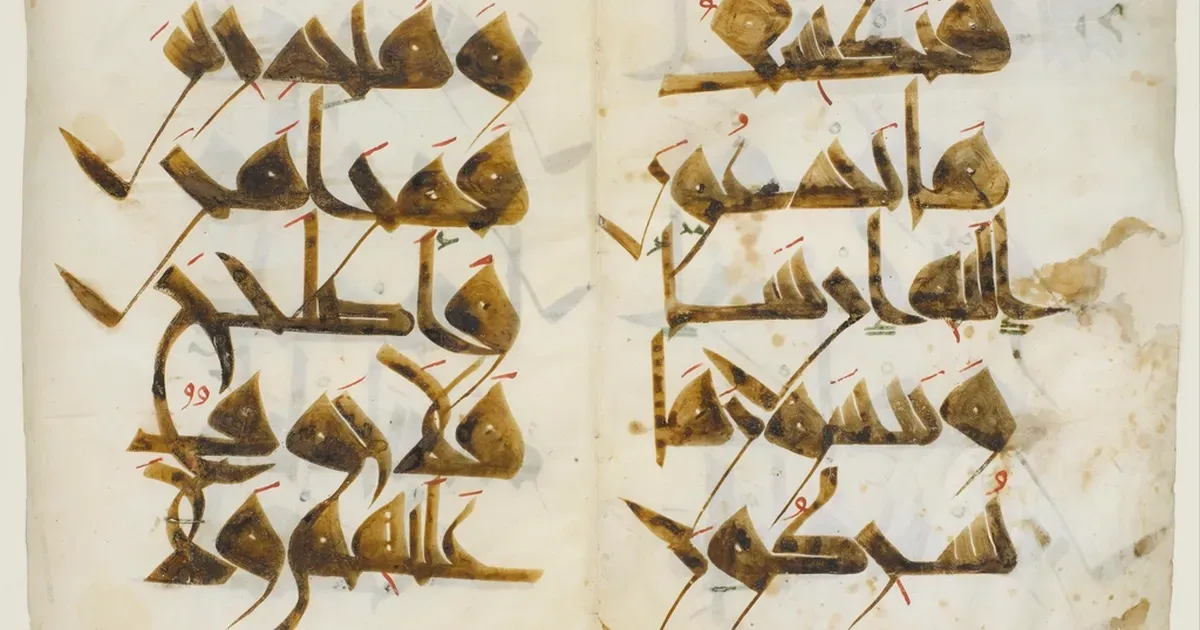
- Hero image: "Bifolium 'Nurse's Qur'an' (Mushaf al-Hadina)", The Metropolitan Museum of Art, CC0 (public domain dedication)